
How to Prepare for CPR Class With Confidence

A CPR class is hands-on for a reason. When an emergency happens, you need more than a general idea of what to do - you need the ability to recognize the problem, act promptly, and use the right technique. Knowing how to prepare for CPR class helps you arrive focused on practicing those skills rather than sorting out paperwork, course requirements, or what to wear.
For many learners, certification is tied to a job, a workplace requirement, or a new career path. For others, it is a practical way to be ready for family, coworkers, or people in the community. A little preparation makes the training day more productive, especially if this is your first course or your previous certification is due for renewal.
Start by Confirming You Have the Right Course
The most useful preparation happens before class day: make sure the course matches the reason you need it. Employers and schools may specify the training organization, course level, CPR level, or whether an AED component is required. Do not assume that any CPR course will meet the requirement.
Basic or emergency first aid courses may suit workplaces and general preparedness needs. A standard or intermediate first aid course may be required for roles with broader workplace responsibilities. Childcare professionals often need a course designed for their setting. Healthcare providers and people working in clinical environments may need BLS CPR, which is a more focused professional-level course with expectations that differ from a general CPR class.
If you are renewing, confirm that your current credential qualifies for a renewal course and has not expired. Renewal options can be shorter, but they still expect you to recall and demonstrate key skills. If the credential has lapsed or your employer requires a different provider, a full course may be the appropriate choice.
Before registering, check the course description and your employer's written requirement if one is available. Look for the credentialing body, the course length, prerequisites, and what certification you receive after successful completion. Phoenix First Aid & Fire offers recognized training pathways through the Canadian Red Cross and Heart & Stroke Foundation of Canada, so learners can select a course that aligns with their role and compliance needs.
How to Prepare for CPR Class Before You Arrive
Read the registration confirmation carefully. It should tell you the class date, start time, location, expected duration, identification requirements, and anything you need to complete beforehand. If there is an online component, pre-course reading, or knowledge check, finish it early rather than trying to complete it minutes before class begins.
You do not need to memorize an entire manual before training. Instructors will teach the current sequence, technique, and decision-making process. Still, a brief review can make new terms feel familiar. Understand the broad purpose of CPR, how an AED supports care, and why immediate action matters when a person is unresponsive and not breathing normally.
Avoid relying on old videos, social media posts, or memories from a course taken years ago. CPR guidance and course standards are updated over time, and your class will teach the current standard used by its certifying organization. Come ready to learn the method your instructor demonstrates, even if it differs from what you were taught previously.
It is also worth thinking through your own reason for taking the course. A teacher may be most concerned about responding around children. A workplace employee may need to understand emergency response procedures and incident reporting. A healthcare learner may need to practice team-based resuscitation skills. Sharing that context with the instructor can help them make the training more relevant to the situations you may face.
Wear Clothing That Lets You Practice
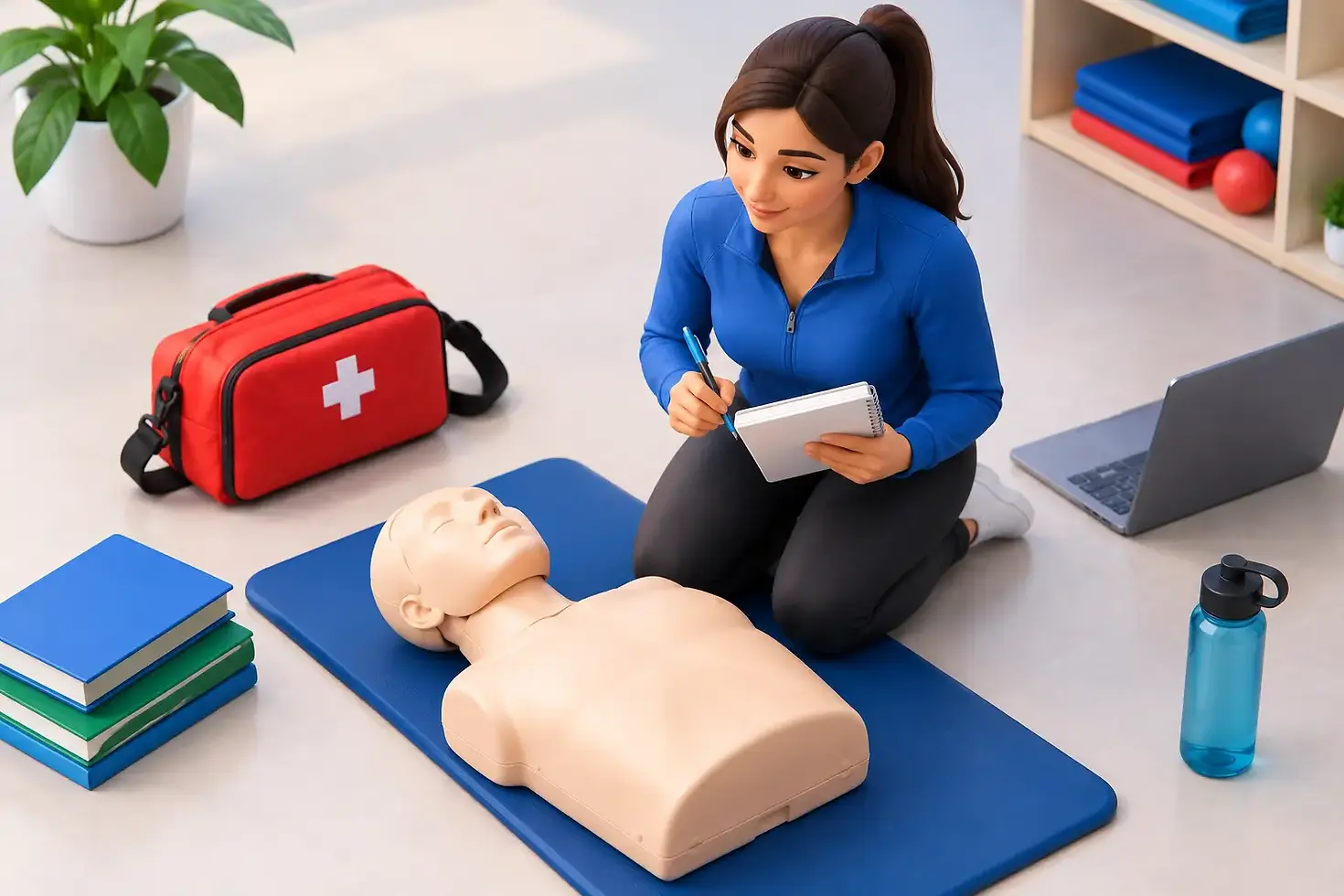
CPR training is active. You will usually spend time on the floor with a manikin, practice chest compressions, work with training AED equipment, and possibly take part in first aid scenarios. Choose comfortable clothing that lets you bend, kneel, reach, and move without distraction.
Closed-toe shoes with good support are usually the practical choice. You may be standing for portions of the course and kneeling for skills practice. Layers can also help because room temperatures vary, particularly during a full-day first aid and CPR course.
Bring what the registration instructions request, including photo identification if needed. A water bottle and a small snack can be helpful for a longer session, although break arrangements vary by course. Keep your phone on silent and plan to be fully present. CPR scenarios require attention, communication, and repetition.
If kneeling, bending, or performing repeated compressions may be difficult because of an injury, mobility limitation, pregnancy, or another health concern, contact the training provider before class. Do not wait until the practical evaluation to raise the issue. The instructor can explain the course requirements and discuss available options, but certification standards still require specific skills to be demonstrated.
Arrive Ready to Participate, Not Just Observe
Plan to arrive 10 to 15 minutes early unless your confirmation gives different instructions. This gives you time to check in, use the restroom, settle in, and begin on time with the group. Late arrivals can miss required content, and some courses may not allow a learner to continue if too much instruction has been missed.
A CPR class is not a lecture where passive note-taking is enough. You will learn best by asking questions, practicing until the sequence feels more natural, and accepting coaching. Effective compressions require the correct hand position, depth, rate, and full chest recoil. These are physical skills that improve with immediate feedback.
Do not be embarrassed if you feel uncertain during your first attempts. Most people do. Manikins are designed to provide a realistic training tool, and instructors expect to correct hand placement, body posture, timing, and AED pad placement. Practice is the point of the course.
When scenarios are introduced, treat them as a chance to build judgment. You may need to check for safety, assess responsiveness, call for emergency help, retrieve an AED, begin CPR, or work with another responder. The goal is not to perform perfectly on the first try. It is to follow a clear process under guidance so you can respond more effectively outside the classroom.
Know What the Skills Evaluation May Involve
Many accredited CPR courses include a skills assessment and may include a written knowledge check. The exact format depends on the course and credentialing body, but learners are generally expected to demonstrate the techniques taught in class.
That can feel intimidating, particularly when certification is needed for a job. The best way to prepare is simple: pay attention during demonstrations, practice each skill seriously, and ask for clarification before the final evaluation. If a step feels confusing, speak up while there is time to repeat it.
Focus on understanding the sequence rather than trying to recite isolated facts. For example, knowing why an AED should be used as soon as possible helps you remember to retrieve it early. Understanding why high-quality compressions matter makes it easier to take correction seriously when an instructor adjusts your position.
For returning learners, avoid assuming that experience removes the need to practice. Renewal classes move efficiently because participants have seen the material before, but they still require engagement. The strongest returning participants review their course details, arrive rested, and remain open to updated guidance.
Set Yourself Up for a Useful Training Day
The night before class, confirm your route, parking or transit plan, and start time. Get adequate rest and eat beforehand, especially for a course that runs several hours. You will concentrate better and have more energy for physical practice.
Bring a learning mindset rather than the pressure to know everything in advance. CPR certification is valuable because it combines recognized standards with hands-on practice. Your instructor's role is to teach and assess; your role is to show up prepared, participate fully, and ask questions until the steps make sense.
The most valuable outcome is not simply leaving with a certificate. It is leaving with the confidence to recognize an emergency, call for help, begin care, and use the skills you practiced when someone needs them.


Comments