
AED Certification Guide Edmonton for Safer Response

An AED is designed to give clear prompts during a cardiac emergency, but confidence with the device comes from practicing the full response: recognizing the emergency, calling 911, starting CPR, applying pads, and working safely until help arrives. This AED certification guide Edmonton learners can use explains how AED training fits into recognized first aid and CPR courses, and how to choose a course that meets a real workplace, professional, or personal need.
What AED Certification Usually Means
People often search for an AED certification when they need proof that they can use an automated external defibrillator. In practice, AED instruction is commonly delivered as part of a CPR course or a first aid and CPR course rather than as a separate, stand-alone credential. Your certificate should clearly reflect the training program completed and the CPR level included.
That distinction matters when an employer asks for a specific qualification. A workplace may require CPR-C with AED training, while a healthcare role may require Basic Life Support (BLS) CPR. Childcare settings, schools, industrial sites, and public-facing workplaces may have their own first aid requirements in addition to AED skills. The right course is the one that matches the duty you are expected to perform, not simply the shortest course with AED in its description.
Recognized training through the Canadian Red Cross or Heart & Stroke Foundation of Canada gives learners and employers a clear, standards-based certification pathway. Before registering, confirm which credentialing body, course level, and certificate duration your employer or regulator accepts.
Why AED Skills Belong With CPR Training
An AED analyzes the heart rhythm and, when appropriate, directs the responder to deliver a shock. It is built for use by trained responders and laypeople, with voice and visual instructions that guide each step. Still, the device is only one part of an effective response.
Quality AED training teaches you to assess scene safety, check responsiveness and breathing, activate emergency medical services, perform chest compressions, locate and apply AED pads correctly, and follow the prompts without creating unnecessary pauses in CPR. You also learn what to do when the person is wet, has a medication patch or chest hair, is a child, or has a visible implanted device. These situations do not make AED use impossible, but they do require calm, correct decisions.
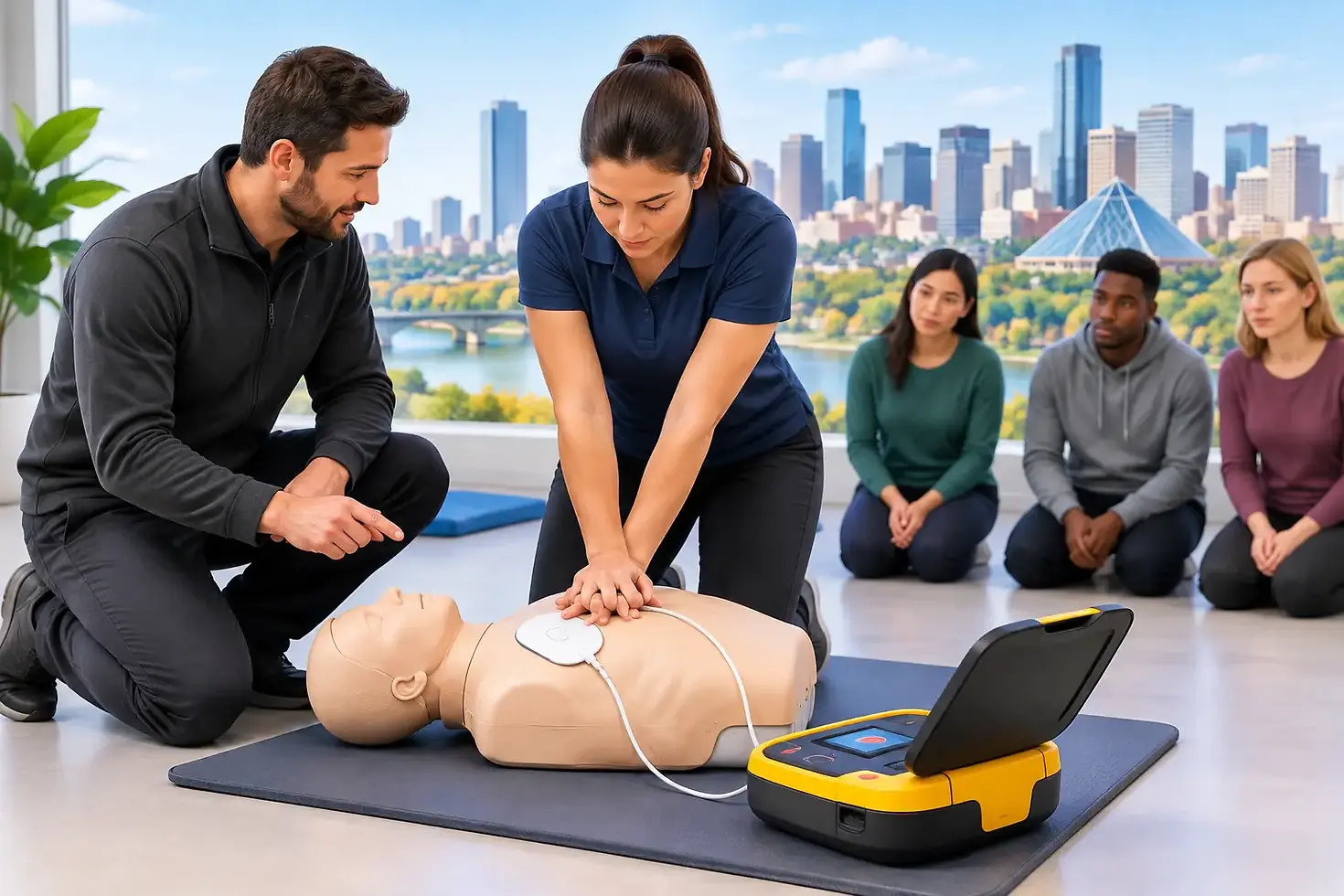
Hands-on practice is especially valuable because real emergencies are stressful and time-sensitive. Reading instructions about pad placement is not the same as opening a training unit, positioning pads on a manikin, clearing the patient, and returning to compressions immediately after the device analyzes or delivers a shock.
Choosing the Right AED Course in Edmonton
Start with the reason you need certification. If you are applying for work, ask the employer for the exact course name before you register. “First aid required” can mean different things across industries. A course accepted for one job may not meet the requirements for another.
For many general workplace and personal preparedness needs, Basic First Aid/CPR-C, Emergency First Aid/CPR-C, Standard First Aid/CPR-C, or Intermediate First Aid/CPR-C may be appropriate options, depending on the work environment and employer requirement. These programs combine emergency response skills with CPR and AED education at the stated level.
BLS CPR is generally the better fit for healthcare professionals and others who are required to respond as part of a clinical or professional team. BLS training focuses on high-quality resuscitation skills, team response, and the protocols expected in healthcare settings. If your role involves monitoring or formal assessment requirements, a BLS CPR Monitoring course may also be relevant.
Childcare First Aid is intended for learners whose responsibilities involve children and who need training aligned with that setting. Although AED principles remain central, child and infant response skills can affect course selection. Do not assume a general adult-focused course will automatically satisfy childcare requirements.
A quick way to narrow your options
Ask three practical questions before booking: What course name does my employer or program require? Do I need first aid as well as CPR and AED skills? Is this a first-time course or an eligible renewal? Those answers usually identify the correct training path quickly.
If you are changing careers or beginning a new role, choose based on the position you are moving into rather than on an older certificate. A certificate that served a previous job may not be sufficient for a new healthcare, childcare, education, or workplace safety responsibility.
First-Time Certification Versus Renewal
Renewal courses can save time for eligible learners, but they are not interchangeable with a full course. Eligibility may depend on your current certificate, whether it remains valid, the original credentialing organization, and the specific renewal rules for that program. Letting a certificate expire can mean you need to complete the full course again.
Check your certificate before you register. Confirm the issue date, expiration date, course level, and training provider. If your employer has a deadline, leave time for the class itself and for any certificate processing requirements. Waiting until the final days of a credential can limit your scheduling options.
A renewal is also a chance to refresh skills that fade when they are not used. CPR compression depth and rate, AED pad placement, and response sequence are physical skills. A practical class gives you an opportunity to correct technique under instructor guidance rather than relying on memory from a course taken years ago.
What to Expect During AED and CPR Training
A well-organized course combines instruction with skill practice and assessment. You will work through realistic emergency scenarios, practice CPR on manikins, and use training AEDs that simulate the prompts of a public-access device. The goal is not to memorize a script. It is to build a reliable sequence of actions you can perform under pressure.
Come prepared to participate physically. CPR requires kneeling, compressing on a manikin, and moving through emergency-response scenarios. If you have a concern that could affect participation, contact the training provider before class so you understand the available options. Being clear in advance helps prevent an avoidable issue on course day.
Bring any information requested during registration, especially if you are completing a renewal. After successful completion, keep your certificate details accessible. Employers may request documentation, and you will want a clear record when it is time to renew.
AED Certification Guide Edmonton: Questions to Ask a Provider
A trusted local provider should make course selection straightforward. Ask whether the program is issued through a recognized credentialing body, whether AED training is included in the selected CPR level, how long the certificate is valid, and whether the course meets your stated employment requirement. It is also reasonable to ask about class format, practical assessment, renewal eligibility, and upcoming schedules.
Phoenix First Aid & Fire offers recognized first aid, CPR, BLS CPR, AED, and renewal training pathways for Edmonton learners. For a first-time participant, clear course guidance can remove much of the uncertainty. For an experienced learner, it can help ensure that a renewal or advanced course matches current job expectations.
Price and convenience matter, but they should not be the only deciding factors. A course that is close to home or available tomorrow may still be the wrong choice if it does not meet your employer's specified level. Conversely, choosing a course beyond your needs can add unnecessary time and cost. The best fit balances compliance, recognized certification, practical skill development, and a schedule you can realistically complete.
Keep the Skill Useful After Class
Certification is a starting point, not a guarantee that every step will feel automatic years later. Notice where AEDs are located at your workplace, gym, school, or community facility. Encourage your workplace to keep emergency equipment accessible and its response plan current. If you are responsible for an AED program, confirm that supplies, pads, batteries, signage, and staff training are reviewed on schedule.
Most importantly, do not wait for a workplace deadline to treat AED training as relevant. A recognized course gives you a practical way to respond when seconds matter, whether the emergency occurs at work, at home, or in the community.


Comments